4.1. Interest Rates
Money market rates softened during the year 2001, amid high levels of liquidity, emanating from:
- the release of statutory reserves by RBZ to commercial and merchant banks, for on lending to productive and export sectors; and
- liquid conditions arising from maturing Treasury Bills which were not rolled over, i.e. reduced government borrowing.
- The commercial banks' minimum lending rate fell from levels in excess of 63%, in December 2000, to an average of 40% in the period February to June 2001. It then declined to 33% for the period July to December 2001. Despite the reduction in lending rates, the gap between lending and deposit rates in 2001 was wide, as deposit rates ranged from 3% to 19% compared to lending rates of 33% to 40%. There is need to reduce this gap, in a bid to encourage savings.
- The Treasury Bill rate fell from over 60% in December 2000, to around 14%, in February, and further down to 11.4%, in Apri1 2001. The Treasury Bill rate then rose to 12.7% in May, and further up to 18.5% in October, and finally closed the year at 27.6%.
- It is therefore, necessary to review the role of the Bank Rate to re-affirm its effectiveness as a monetary policy tool.
- These low interest rates, in a period of surging inflation, led to negative real interest rates, which discouraged savings and negatively impacted on pension funds, some of whose investments are closely linked to interest yields on the money market.
- Consequently the first quarter of 2001 saw a shift of investments from the money market to the equity and property markets. Due to this investment shift, the industrial index soared to record levels of 56 858 in August 2001, compared to 17 984 in December 2000. When the phenomenal increase of share prices on the stock market stabilised, resources found their way to the foreign exchange market; thus fuelling the parallel market and create an asset bubble. This asset bubble, characteristic of speculative tendencies in the market, pushed up prices in the equity and property markets. Notwithstanding increases in asset prices, these activities are mere transfers of funds from one sector to another, which do not result in economic growth and creation of new wealth. An economy such as Zimbabwe needs economic growth based on new investment in the productive sectors.
4.2. Inflation
- The year 2001 witnessed the highest inflation ever recorded in Zimbabwe. The year-on-year rate of inflation was on an upward trend, beginning the year at 57.0%, rising to triple digits of 103..8% and to 112.1% in November and December, respectively. The rate of inflation averaged 71.9% during the twelve months compared to 55.9% for 2000 (see Table 5 and Graph 5).
- Inflationary pressures during the year 2001 emanated from the following factors:
- high domestic bank financing of the budget deficit, in the absence of donor support;
- continued shortage of foreign currency, which led producers to source foreign currency on the parallel market at high rates, a cost subsequently passed to the consumers;
- high levels of money supply growth, which rose from 57% in January to a record high of 102.7% in December 2001, against the background of a contracting economy, due to supply bottlenecks;
- regular 20% increases in electricity tariffs; and
- increase in fuel price by an average of 70% effected on June 12, 2001
- In addition, the macroeconomic instability created uncertainty and inflationary expectations in the economy. These expectations became self-fulfilling, as economic agents increased prices in anticipation of price increases in other critical inputs, such as labour and raw materials.
- Inflation in 2001 was, therefore, largely a combination of 'cost-push' and 'demand-pull' pressures. The high energy costs and the escalating cost of imported inputs, fed into inflation. On the other hand, the high levels of liquidity in a contracting economy, created demand-pull inflationary pressures.
- In order to contain inflationary pressures, Government re-introduced price controls on some basic commodities such as bread, sugar, maize meal, salt, cooking oil, margarine, beef, pork, chicken, soap and milk on October 11, 2001. However, this development was accompanied by the following repercussions:
- reduction in quantities produced, leading to shortages in the market and an increase in prices;
- a reduction in the quality, and of assay standards of some products, as manufacturers sought to cut costs; and,
- encouragement of rent-seeking behaviour, whereby some economic agents bought controlled products in large quantities for re-sale at exorbitant prices in the black market
- It is also important to note that although price controls were introduced to cushion consumers from the rapid increase in the price of basic commodities, this had a limited impact on the cost of living because:
- price controls were imposed mainly on basic foodstuffs, which constitute about 33% of the day to day consumption basket;
- price controls led to shortages of some of the controlled goods, which in turn fuelled black market activities, resulting in scarce commodities being sold at exorbitant prices; and
- money supply grew by 102.7% in December, in an environment of declining output, a situation of "too much money chasing a few goods" arose. This exerted upward pressure on prices, and compromised the effectiveness of price controls.
- Therefore, price controls alone did not yield the intended effect of reducing inflation. For price controls to have a meaningful impact on inflation, they should be part of a working Social Contract. Besides, even in such a context, prices should be set rationally and realistically, not arbitrarily, taking into account production and distribution costs.
Graph 5
Inflation�
2000 and 2001 (%)
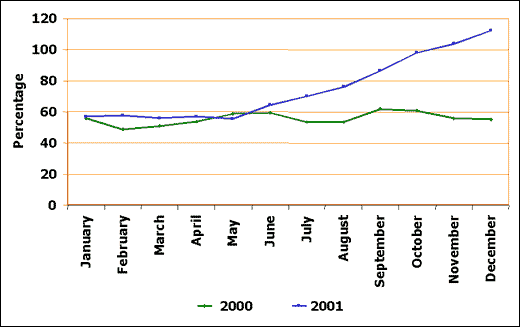
Source: Central Statistics Office
|
4.3. Exchange Rate
- The exchange rate remained pegged at ZWD55 to USDl throughout the year 2001. Pegging the exchange rate at this level against a background of high inflation vis-Р°-vis that of our major trading partners (see Table 6) had serious repercussions on export competitiveness, foreign currency availability in the economy and overall economic performance.
- The shortage of foreign currency experienced throughout 2001, was one of the major constraints to economic growth and development. There is urgent need to adjust our exchange rate in line with key fundamentals, if the economy is to recover and grow.
4.4. Financing facilities
-
Productive Sector Facility (PSF)
The total cumulative utilisation of the PSF amounted to Z$16 078 million by 28th December 2001. Agriculture dominated the usage of the facility accounting for Z$7 608 million or 47.3% of the total. Manufacturing and mining utilised Z$6 894 million (42.9%) and Z$893 million (5.6%) respectively. Tourism accounted for Z$683 million (4.2%) of the total.
-
Export Finance Facility
The total cumulative utilisation amounted to Z$16 078 million by 28th December 2001. Sectorally, manufacturing remains the largest beneficiary of the facility accounting for 51.3 % (Z$8 307 million), followed by mining and agriculture, Z$5 789 million (35.7%) and Z$2 098 million (12.9%). Utilisation by the tourism sector remains low at Z$2 098 million (0.02%).
-
Utilisation of the SME’s Revolving Fund
As at 31 January 2002, about $950 of the $1 billion was allocated to the participating ministries for disbursement to beneficiaries. The Ministry of Youth Development, Gender and Employment Creation, which was allocated $450 million disbursed $212.5 million, to a total of 4 885 projects, creating about 24870 jobs.
The Ministry of Industry and International Trade was also allocated $450 million. A sum of $349 million was disbursed to support projects in agriculture, retailing, construction, manufacturing and services with a total of 1 900 jobs being created.
The Ministry of Public Service, Labour and Social Welfare was allocated the balance of $50 million. Of this amount, $47.65 million was disbursed to various micro finance institutions for further disbursement to target beneficiaries. About $20.05 million was disbursed to 331 beneficiaries.
|