3.1. Overview
The 2001 budget was characterised by a 19% under-expenditure of voted funds; and revenue collections which were 3% below target (see Table 4).
3.2. Revenues
Total revenue collected for 2001 amounted to $136 billion against a target of $140 billion, representing a 3% negative variance. Revenue collection saw most sub-heads performing within targets. However, the following were below target:
- customs duty (14%)
- excise duty (10%)
- The under performance of customs duty was due to the fact that the target was based on an annual average exchange rate of US$1:Z$88.00. However, the rate remained pegged at US$l: Z$55 throughout the year, which led to less customs revenue. In addition, the weak performance of customs duty also reflects low imports, due to foreign currency shortages.
- As regards the excise duty, the failure to meet the target was mainly due to consumers moving away from excisable products such as beverages, to basic commodities, as the economic situation worsened.
- Pay-As-You-Earn exceeded by an impressive 22%, mainly due to higher salary increases awarded than estimated during budget formulation, e.g. 65% in the private sector against the estimate of 50%.
- Corporate tax target was exceeded by an impressive 22%, largely due to an exceptionally high performance by companies in the financial sector.
- In addition to the above, the Zimbabwe Revenue Authority intensified the tax-net exercises, which impacted positively on revenue collection.
3.3. Expenditures
- Total expenditure for 2001 was $181.4 billion, against a target of $223.3 billion, resulting in under expenditures of $41.9 billion. This represents a variance of 19%. The under-expenditure is largely attributable to:
- Savings made on domestic debt interest payments due to lower interest rates which prevailed in 2001. This resulted in an expenditure of $41.1 billion against a provision of $81 billion.
- Foreign currency shortages, which resulted in failure to meet our foreign debt obligations, as only $100 million was utilised, against a budget of $11.7 billion. This 99% under- expenditure which saw total external payment arrears accumulating to US$762.7 million by the end of 200l.
- Foreign currency shortages also restricted foreign travel and importation of goods and services by Government.
- Fuel shortages, which reduced travel by government officials.
- Expenditure controls through the Pub1ic Finance Management System (PFMS).
3.4. Budget Deficit
- As a result of the foregoing, the budget deficit was initially estimated at 15% of GDP and revised down to 12%. However, the outturn for 2001 stood at $45.4 billion, which is 9.0% of GDP. The deficit was largely financed from domestic bank sources. Domestic credit to government grew by 129.3%, while credit to the private sector grew by 59.8%. This led to the crowding out of the private sector, and stifled economic growth.
- It should be noted, however, that the decline in the deficit was largely due to deferred expenditures, rather than actual expenditure cuts, which have a stabilisation effect on the economy. As soon as the balance of payments situation improves, most of these expenditures will have to be met, thus creating pressures in the economy. Thus there is still urgent need for Government to plan its expenditures in line with revenue collection and what the economy can afford. This is the only way to ensure macro-economic stability, growth and development.
3.5. Debt Restructuring
- The year 2001 saw Government restructure its domestic debt from short to long term. In December 2000, 94% of Government domestic debt was short term. By June 2001, the short-term component had been reduced to 72%. The year 2001 ended with the short-term debt further reduced to 67%. This is in line with the debt restructuring policy, which targeted that short term debt should not exceed 7O%, and at least 30% becomes medium to long term. During the period under review, Government debt with a tenure of more than one year increased from 6% to 33% (see Graph 4). This exercise reduced pressure on the servicing of Government domestic debt, thus unlocking resources to other Government priorities.
Graph 4
Restructuring
Government Domestic Debt
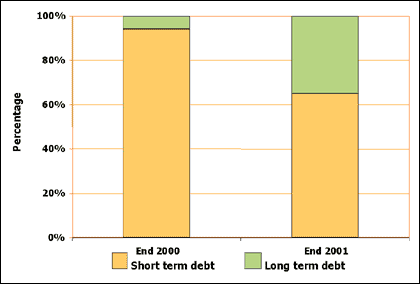
Source: Reserve Bank of Zimbabwe
|
3.6. Privatisation
- The privatisation programme progressed slowly in 2001. While the budget had targeted to raise 2$22 billion from the sale of assets, only 2$7.1 billion, 32.3% of the target, was realised. This amount was raised through the divestiture of Government stakes in NOC2IM, COTTCO, 2IMRE, Dairibord, WS Craster and Zimbabwe Development Corporation (ZDC).
- Failure to raise the targeted 2$22 billion made it more difficult for Government to service its external debt, as part of the privatisation proceeds that had been earmarked for that purpose.
|