2.1. Overview
The major sectors of the economy experienced declines of more than 5%. Performance of these sectors was negatively affected by:
- high rates of inflation which increased cost of production and reduced export competitiveness;
- low commodity prices mainly for agriculture and mining;
- acute foreign currency shortages, which resulted in reduced imports of raw materials, spare parts and machinery;
- the fixed exchange rate; and
- shrinking domestic demand, due to increased unemployment and declining purchasing power
2.2. Agriculture
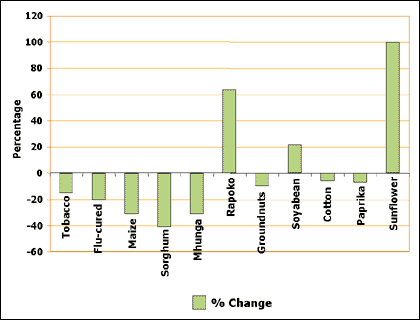
- The agriculture sector is estimated to have declined by 12.2% in 2001 (see Table 1 and Graph 1). The specific factors that affected performance of this sector include:
- unfavourable weather conditions, characterized by a mid-season dry spell, and flooding during the 2000/2001 agricultural season;
- reduced agricultural productivity associated with the initial stages of land reform; and
- reduced agricultural productivity associated with the initial stages of land reform.
- Maize
Maize production is estimated to have declined by 31% from a total of 2.1 million tonnes in 1999/2000 season, to about 1.4 million tonnes in 2000/2001 season. This is against a national requirement of 1.8 million tonnes. As a result we are currently importing maize to make up for the shortfall.
- Cotton
Cotton production also declined by 5.7%, from a record of 353 000 tonnes in 1999/2000, to 333 050 tonnes in 2000/2001 season.
- Tobacco
The production of tobacco, the economy's main foreign currency earner, declined by 15.4%, from 245,2 million kg in 2000, to 207,5 million kg, in 2001.
- Tea
Tea production increased marginally by 4.3% from 21 818 tonnes in 2000 to 22 746 tonnes in 2002.
- Coffee
Coffee output increased by 33% from 6 000 tonnes in 2000, to 8 800 tonnes in 2001. The low output in 2000 was attributed to the cyclone Eline.
- Cattle
The national cattle herd declined by 4.5% from 5 908 million in 2000 to an estimated 5.5 million in 2001.
- Timber
Timber production declined by 13.4% from 395 292 cubic metres during the twelve months to March 2000, to 342 520 cubic metres over the same period to March 2001. Of the timber produced by March 2001, 333 488 cubic metres was pine and the balance was eucalyptus. The decline in timber production is attributed to the effects of the Cyclone Eline and the harsh macroeconomic environment.
- Horticulture (Flowers, Citrus, Fruits and Vegetables)
About 21 749 tonnes of flowers were exported, at an average price of US$3 600 per tonne in 2001, compared to 17 900 tonnes, at a price of US$2 500 per tonne in 2000. The upward trend in export of flowers is attributable to the locally bred new varieties, which are fetching high prices on overseas auction floors. During the same year, 45 840 tonnes of citrus were exported, compared to 39 000 tonnes in 2000. Fruits and Vegetables exports dropped from 10217 tonnes in 2000, to 9 955 tonnes in 2001, as a result of changes taking place on the farms.
- Sugar
Production of sugar dropped by 4.8%, from 537 491 tonnes in 2000, to 511 598 tonnes in 2001.
Graph 1
Crop Production�
(Percentage Changes: 2000/2001 season)
Source: Crop Forecasting Committee
|
2.3. Manufacturing
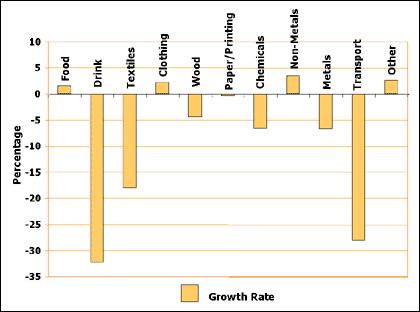
The volume of output in the manufacturing sector for the first nine months of2001 fell by 10.1%, compared to the same period in 2000 (see Table 2 and Graph 2). Major declines were recorded in the following sub-sectors:
- Beverages and tobacco
This sub-sector recorded a decline of 32.2% in 2001 as consumers moved away from purchasing luxury products such as beverages in favour of necessities, as the economic situation worsened.
- Transport and equipment
This sub-sector recorded a slump of 28%. It was seriously hampered by the shortage of foreign currency as most of its inputs and components are imported.
- Textile and ginning
The Textiles sub-sector declined by 18.1% in 2001. This was mainly due to the loss of major export markets and increased competition from South Africa and South East Asia.
- Metals and metal products
This sub-sector declined by 6.7% due to inadequate working capital and capacity constraints at ZISCO, which resulted in failure to supply steel to major markets; and decline in international prices due to the slow-down in the world economic growth. However, minor growth in output was recorded in the following sub-sectors:
- chemicals (4.9%);
- non-metallic minerals (3.5%);
- clothing and foot wear (2.2%); and
- foodstuffs (1.6%).
Graph 2
Manufacturing Sector Volume Index
(Jan – Sept 2001)
Source: Central Statistics Office
|
2.4. Mining
-
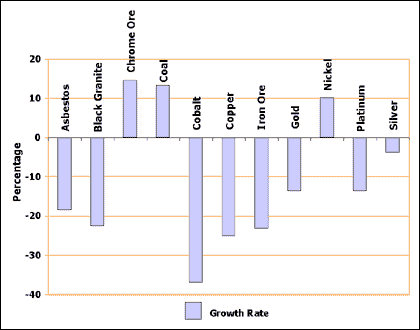
Mineral production for the period January to September 2001 declined by 6.8%, compared to the same period in 2000 (see Table 3 and Graph 3). Major declines were recorded as follows:
- gold (13.7%);
- asbestos ( 18.5% );
- black granite (22.6%); and
- iron ore (23.2%).
The decline in mining production is largely attributable to the following factors:
- scaling down of production, due to prohibitive costs;
- problems at Blast Furnace No.4 at ZISCO, which reduced demand for Iron Ore.
-
Gold
A marked decline in gold production was registered in 2000, due to closure of gold mines. In a bid to avert further closures, Government introduced a Gold Price Support Scheme in April 2001. Regrettably, gold production still declined in 2001, in spite of a floor price of US$343 (Z$18 865) per ounce introduced in April, and later revised to US$430 (2$23 650) in August, and closed at US$456.7 (Z$25 119) in December 2001.
-
Coal
Notwithstanding the increase in coal production of 13.3%, coal output was 3.4 million tonnes in 2001, which is still far below the normal average of 5 million tonnes (1990 to 1999).
-
Nickel
Nickel production grew by 10.1%, due to increased output at Bindura Nickel mines, and reduction of in-process inventories within the plant. However, it is important to mention that Bindura Nickel Corporation, the largest producer of nickel in Zimbabwe, is reported to be operating below 60% of its installed capacity.
-
Chrome
A growth of 14.6% was realized, due to a more efficient smelting process, which requires less ore to produce the same amount of alloy.
-
Platinum
The envisaged operations of Ngezi and Unki mines, and installation of a refinery, provide an impetus for growth in the mining sector.
Graph 3
Mining Sector Volume Index�
(Jan – Sept 2001)
Source: Central Statistics Office
|
2.5 Tourism
-
The tourism sector started declining in 2000, due to the negative publicity related to the land reform programme and the perceived unstable political climate. In 1999, US$201.6 million was received, and in 2000, US$124.7 million was generated, marking a 38.1% decline. The decline continued into 2001 as only US$72.2 million was realised for the period January to November 2001 compared to US$116.5 million, for the same period in 2000, representing a 38% decline in tourism earnings. This is the worst consecutive decline experienced in the sector since independence.
-
However, in terms of tourist arrivals from overseas, the figures for the period January to September 2001 indicate a 6% increase from 349 663, in 2000 to 369 964 in 2001. During the same period, regional tourists increased by 43%, from 998 554 to 1 432 186; while the average room occupancy rate increased slightly from 40% in 2000 to 41% in 2001. This is largely attributable to tourists who came to witness the solar eclipse. It should also be noted that most of the regional tourists are traders, who do not spend large amounts of money on traditional tourist activities. Instead, these traders take advantage of the depreciated local currency to buy goods for resale in home countries.
|